
Moving Goods by Metro? You Now Need an E-Way Bill
Metro trains in India no longer carry only passengers. Delhi Metro has tied up with Blue Dart to move cargo in non-peak hours, and other metro corporations have started parcel services of their own. The idea is simple — the trains are running anyway, so use the empty capacity for city freight.
The tax law has now caught up. From 1 November 2026, goods moved by metro railway follow the same e-way bill rules as goods moved by Indian Railways.
Upload this image in the Photo box of the article form — it is supplied separately as img/metro-rail-eway-bill.png
What changed
Notification No. 05/2026-Central Tax dated 26 October 2026 amended Rule 138(2A) of the CGST Rules. Two changes:
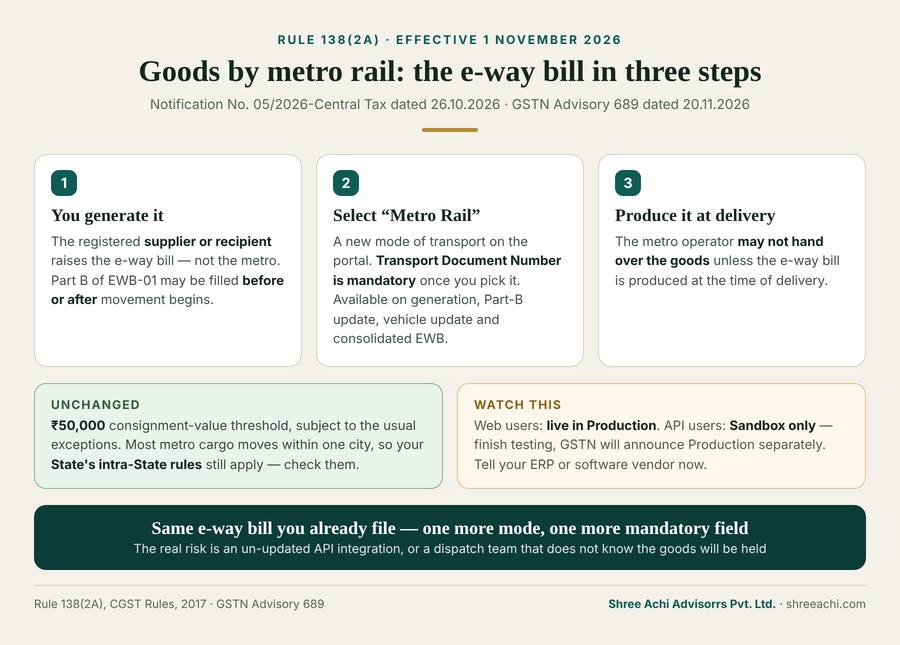
● The words "or metro railway" were added after "by railways". So where goods move by metro, the registered supplier or recipient generates the e-way bill — and Part B of EWB-01 may be filled before or after the movement starts.
● The proviso now reads "railways or metro railway". So the metro operator cannot hand over the goods unless the e-way bill is produced at the time of delivery.
Why it was needed
"Railways" is not defined anywhere in the GST Rules. Metro systems run under a separate law — the Metro Railways (Operation and Maintenance) Act, 2002 — and are legally distinct from Indian Railways. So nobody was sure whether metro cargo was covered by Rule 138(2A) at all.
The question became urgent when DMRC planned a depot-to-depot cargo pilot and found that the e-way bill portal was built for Indian Railways and did not handle metro movements properly. The 57th GST Council, which met on 8 October 2026, recommended the fix.
The portal is ready
GSTN Advisory 689, dated 20 November 2026, added Metro Rail as a mode of transport on the e-way bill system.
● You can select it while generating an e-way bill, updating Part-B, updating the vehicle, and generating or re-generating a consolidated e-way bill
● Transport Document Number (TDN) is mandatory when you select Metro Rail
● Web users: live in Production now
● API users: released in Sandbox only. Finish your testing — GSTN will announce the Production date separately
If you use an API or an ERP integration for e-way bills, this is the line that matters. Do not assume your software is ready.
What has not changed
● The ₹50,000 threshold stands. An e-way bill is needed where consignment value crosses ₹50,000, subject to the usual exceptions.
● State rules still apply. Most metro cargo moves inside one city, so it is an intra-State movement. Several States have their own thresholds and exemptions for intra-State movement. Check your own State's notification before you decide you need nothing.
● The obligation is yours. The supplier or the recipient generates the e-way bill. The metro operator only checks it before releasing the goods. Do not assume the transporter will do it for you.
What to do now
Two things still unclear
The advisory does not say what format the Transport Document Number should take, and it says nothing about vehicle number entries for metro. Until GSTN clarifies, take the TDN exactly as your metro operator issues it and keep a record of what was entered.
In short
Metro freight is a real option now, and from 1 November 2026 it is a documented one. The compliance is not new or complicated — it is the e-way bill you already know, with one more mode to select and one mandatory field to fill. The only genuine risk is an API integration that has not been updated, or a dispatch team that does not know the goods will be held at delivery.
Every situation differs. Talk to us before you act on anything above.
This article is general information, not professional advice. Tax law changes frequently — please confirm your position with us before acting.