
If Your Buyer Pays the GST, That Sale Counts as Exempt
A goods transport agency raises a freight bill with no GST on it, because the customer pays the tax under reverse charge. No output tax, nothing to deposit. So the accountant claims full input tax credit on the workshop bills, the office rent and the audit fee.
That is wrong, and it is an expensive mistake.
When you make a supply and the buyer pays the tax on it, the law treats that sale as an exempt supply in your hands. Part of your input tax credit has to go back.
The rule
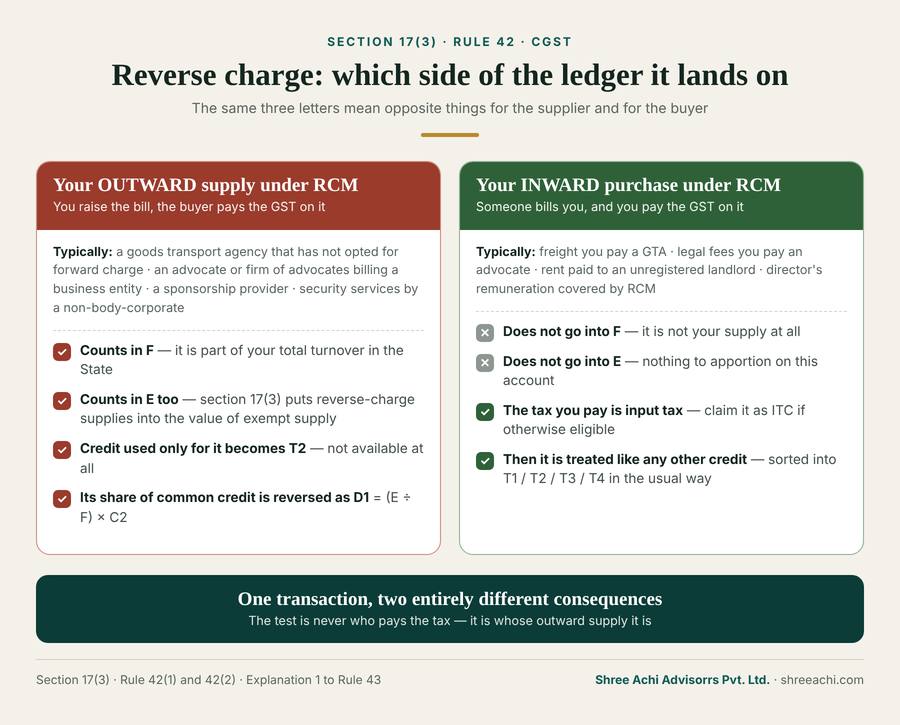
It is in the Act, not just the Rules. Section 17(3) says the value of exempt supply "shall include supplies on which the recipient is liable to pay tax on reverse charge basis."
The reason is simple. You paid no output tax on that sale. So there is nothing for the credit to set off against. The law treats it like credit used for an exempt supply.
Upload this image in the Photo box of the article form — it is supplied separately as img/rcm-exempt-supply-rule-42.png
Who this affects
If any of these appear in your sales ledger, this applies to you:
● Goods transport agency services, where you have not opted for forward charge
● Legal services by an advocate or a firm of advocates to a business entity
● Sponsorship services
● Security services supplied by anyone other than a body corporate
● Renting of a motor vehicle to a body corporate
What it means in your Rule 42 working
● The value of that sale goes into E (exempt supplies) and into F (total turnover)
● Credit on things used only for that line is T2 — not available at all
● Its share of your common credit is reversed as D1 = (E ÷ F) × C2
● The reversal goes in GSTR-3B Table 4(B)(1), with the annual true-up under Rule 42(2)
An example
A Kolkata logistics company, October 2026. One office, two lines of business.
● Taxable warehousing: ₹40 lakh
● Freight billed as a GTA, customer pays the tax: ₹60 lakh
● So F = ₹1 crore and E = ₹60 lakh. Sixty per cent of turnover is "exempt."
Credit for the month:
● T (total credit) ₹6,00,000
● T2 (only for the freight line — truck repairs, truck insurance) ₹1,50,000
● T3 (blocked under 17(5)) ₹20,000
● T4 (only for warehousing) ₹2,30,000
Working down:
Sixty per cent of the turnover carried no tax, so sixty per cent of the common credit goes back.
The number worth looking at
If that freight had been billed under forward charge instead, the freight leaves E. D1 becomes nil. The ₹1,50,000 of truck repairs becomes eligible too. Credit for the month goes from ₹3,10,000 to ₹5,80,000.
That is ₹2,70,000 in one month, from one election. The exact gain depends on which rate option you choose, so run the numbers for your own case — but run them, every year.
Three things people get wrong
1. This is about your sales, not your purchases. If you pay tax under reverse charge on something you bought — freight, legal fees, rent to an unregistered landlord — that is not your supply. It does not go into your E or F. The tax you paid is input tax, and you claim it normally.
2. Interest income does not count. Interest on deposits, loans and advances stays out of E. (Banks, financial institutions and NBFCs are the exception — for them it is very much in.) Duty credit scrips are also out.
3. Two older exclusions have changed. The exclusion for ocean freight on exports was removed on 4 August 2023 — do not apply it any more. And from 1 October 2023, supplies from duty-free shops at arrival terminals must be included in E.
What to check now
One more point, said plainly
Some professionals argue that a reverse-charge supply is still a taxable supply, so no reversal should be needed. It is a fair argument. But the words of section 17(3) are against it, and that is how the department reads it. If you want to take that position, take it deliberately, work out what is at stake, and keep it visible in your records — do not simply claim full credit and hope.
Every situation differs. Talk to us before you act on anything above.
This article is general information, not professional advice. Tax law changes frequently — please confirm your position with us before acting.