
Closing a GST Registration Becomes Automatic from 1 December 2026
The phrase "automatic cancellation of GST registration" is doing the rounds, and it is frightening people who have no reason to be frightened.
So first, the important part. This is cancellation that you ask for. You apply to surrender your own registration, and the portal now closes it without an officer touching the file. The department is not going to cancel your registration automatically. That is a different subject, and it is covered at the end.
What changed
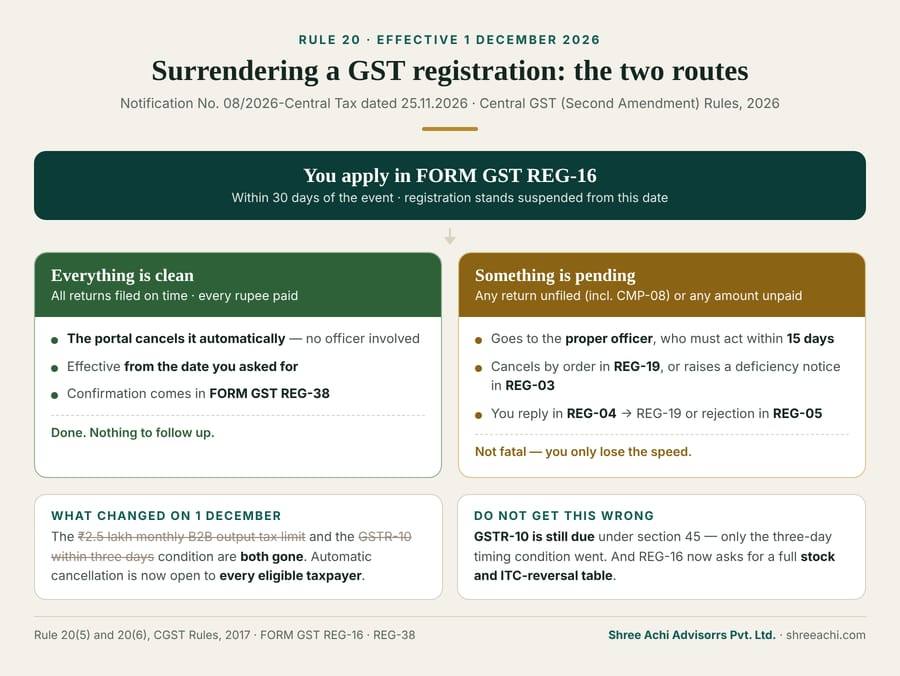
Notification No. 08/2026-Central Tax dated 25 November 2026 — the Central GST (Second Amendment) Rules, 2026 — substituted sub-rules (5) and (6) of Rule 20, with effect from 1 December 2026.
Rule 20 had already been rewritten a month earlier, from 1 November 2026, to allow system-based cancellation. But it came with two conditions:
● your monthly output tax on supplies to registered persons must never have crossed ₹2.5 lakh, or
● you must have filed GSTR-10 within three days of the due date of the returns
Both conditions are now gone. From 1 December 2026, automatic cancellation is open to every eligible taxpayer, whatever the size of the business and whatever the B2B turnover.
Upload this image in the Photo box of the article form — it is supplied separately as img/gst-cancellation-dec-2026.png
The only condition that matters now
The portal will cancel your registration electronically, from the date you asked for, if two things are true:
That is it. You get the confirmation in FORM GST REG-38, and the matter is closed.
If something is pending
Under the new sub-rule (6), if any return is unfiled — including CMP-08 for a composition taxpayer — or any amount is unpaid, the application does not get cancelled automatically. It goes to the proper officer for examination.
From there it is the familiar route. The officer must act within 15 days: either cancel by order in REG-19, or issue a deficiency notice in REG-03. You reply in REG-04, and the officer either cancels in REG-19 or rejects in REG-05. If you do not reply, the application is treated as rejected. If the officer does not act in time, the application is deemed approved.
So a pending return does not kill your application. It only costs you the speed, and puts a human being back in the loop.
The application form has changed too
FORM GST REG-16, the cancellation application, was revised with effect from the same date. Two additions worth knowing before you sit down to fill it:
● A detailed table of stock, semi-finished goods, finished goods and capital goods, showing the input tax credit to be reversed
● An option to file a nil return for the period up to cancellation
So the ITC reversal working is now part of the application itself. Prepare it before you start, not while the form is open.
Two other points on the application that have not changed: it must be filed within 30 days of the event that caused the closure (that limit does not apply where a sole proprietor has died), and your registration stands suspended from the date of the application until the matter is finished.
GSTR-10 is still required
The three-day GSTR-10 condition has gone, and this is being misread. Dropping the condition does not drop the obligation. The final return under section 45 still has to be filed where it applies. You simply no longer need it filed within three days to qualify for automatic cancellation.
What to do before you apply
The other thing, coming 1 April 2027
Separately — and this is the part that actually involves the department — system-based suspension of registrations is due from 1 April 2027. The system will be able to suspend a registration for non-filing of returns and for failure to furnish bank details, with a notice in REG-31 giving 30 days to comply. Non-compliance can lead to cancellation, and revocation will be available through REG-21 within 180 days.
That is a separate reform, on a separate date. It is worth knowing about now, but it is not what is happening on 1 December.
In short
If you are closing a business, a branch registration or a dormant GSTIN, this is good news and nothing more. Clean up the returns, clear the dues, prepare the stock and ITC working, and the cancellation now happens on its own — no officer, no follow-up, no waiting.
Every situation differs. Talk to us before you act on anything above.
This article is general information, not professional advice. Tax law changes frequently — please confirm your position with us before acting.